
Expert Roof Flashing Repair in Plano, TX
Roof flashing protects every joint, transition, and penetration where water is most likely to enter. When flashing separates, corrodes, or lifts, the result is often a slow, persistent leak that damages decking and interior surfaces long before it becomes obvious. We inspect, repair, and replace flashing across all roof types in Plano and Collin County.
Types of Roof Flashing We Repair in Plano
Every roof has multiple flashing details, and each one serves a specific purpose. When one fails, the leak it causes can be difficult to trace because water often travels along the metal before reaching the interior. Here are the flashing types we encounter most frequently.
Step flashing along walls and dormers
Step flashing consists of individual metal pieces woven into each row of shingles where the roof meets a vertical wall. When pieces shift, separate, or are improperly installed, water enters behind the wall covering and travels downward — often appearing inside as stains well below the actual failure point. Many homes in Plano's Prestonwood and Deerfield neighborhoods have wall-to-roof transitions that rely heavily on step flashing.
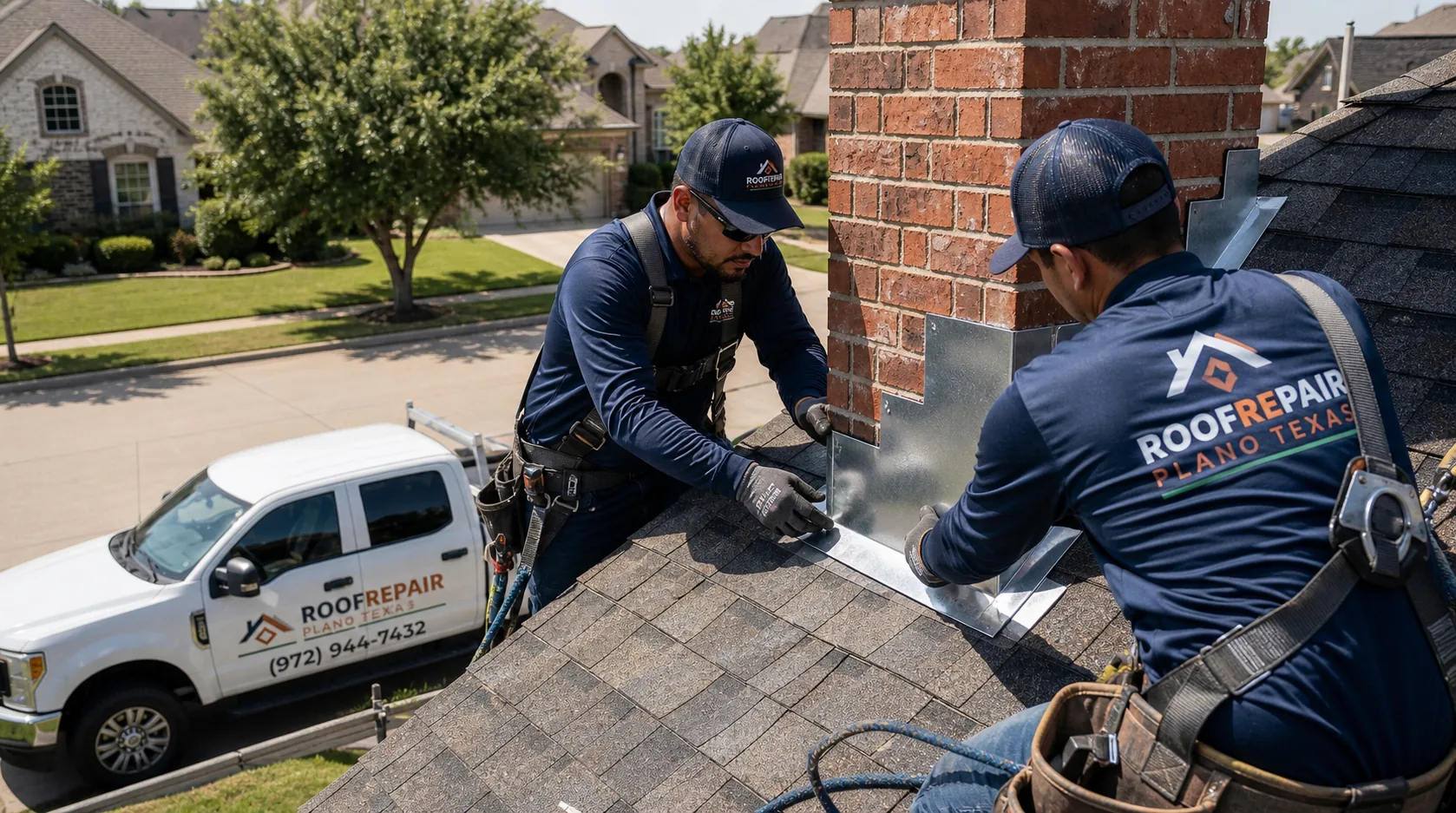
Chimney flashing and counter flashing
Chimney flashing involves a two-part system: base flashing that sits against the roof and counter flashing that overlaps from the chimney masonry. Mortar joints deteriorate over time, and the metal can separate from the brick as the chimney and roof structure settle at different rates. This is one of the most common flashing leak sources on older Plano homes.
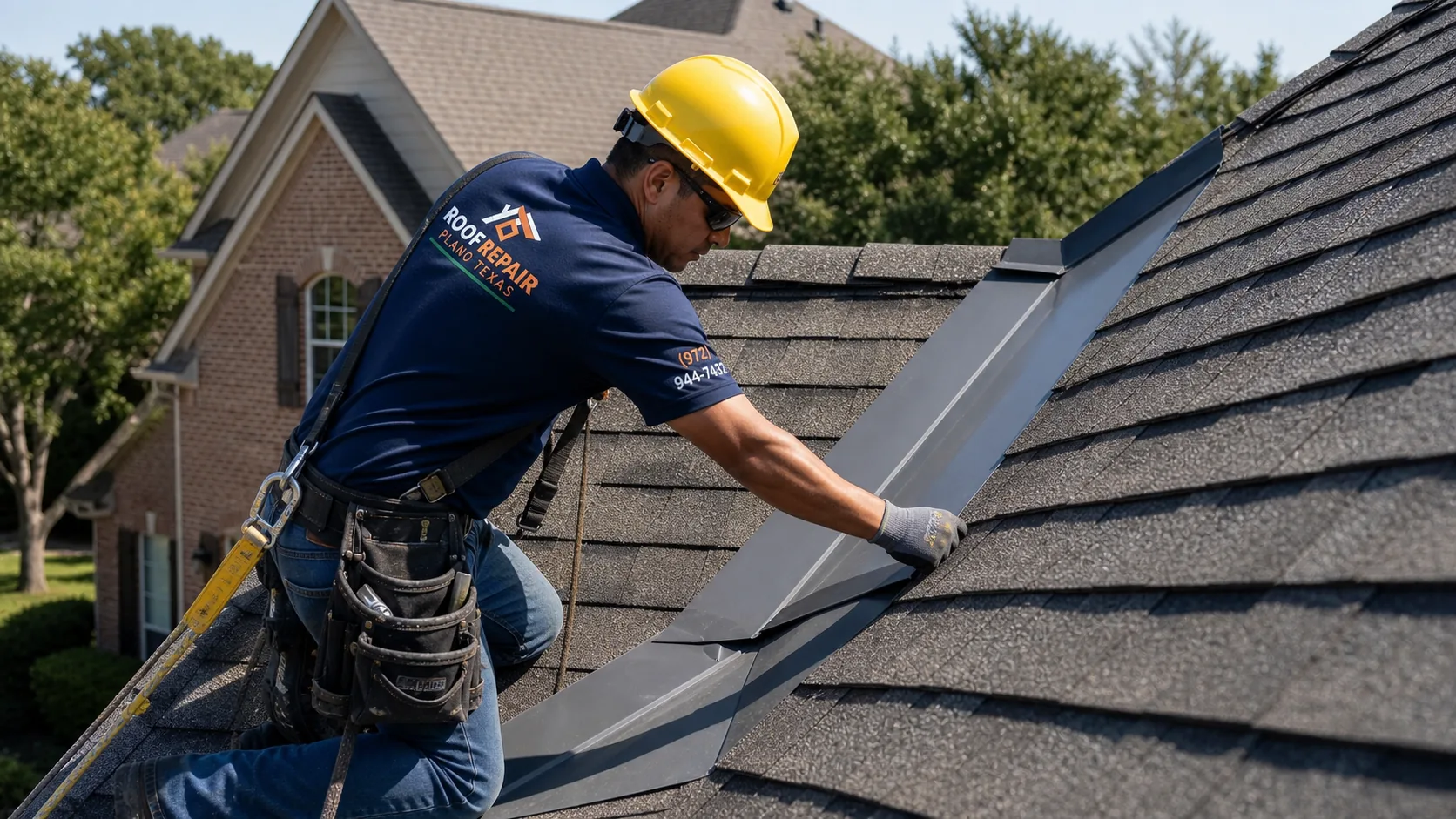
Valley flashing between roof planes
Roof valleys channel a concentrated volume of water from two intersecting roof planes. The flashing in these valleys endures more water flow, more debris accumulation, and more thermal stress than most other flashing details. Failed valley flashing can cause major water entry during heavy storms — a significant concern in North Texas where spring thunderstorms regularly deliver several inches per hour.
Drip edge, skylight, and roof-edge flashing
Drip edge protects the fascia and prevents water from wicking back under the shingles at the eaves. Skylight flashing seals the curb where the unit sits on the roof surface. Both can fail from wind uplift, hail impacts, or improper installation — allowing water to bypass the roofing material and enter directly into the wall or ceiling assembly.
Why Roof Flashing Fails in Plano
Plano's climate puts exceptional stress on every flashing detail. Summer surface temperatures can exceed 160°F, followed by rapid cooling during overnight thunderstorms. This repeated thermal expansion and contraction loosens fasteners, opens lapped joints, and breaks down the sealants that keep flashing watertight.
Wind is another factor. Straight-line winds from North Texas thunderstorms can lift flashing edges, peel back drip edge, and drive rain beneath improperly secured details. After a hailstorm, dented or punctured flashing may still appear functional from ground level but can channel water behind the roofing material. Previous repairs that relied on surface caulk instead of proper mechanical attachment also tend to fail within a few seasons as the sealant degrades in the Texas heat.
Post-Storm Flashing InspectionsHow We Repair Roof Flashing the Right Way
Surface caulk alone is rarely a durable solution. Proper flashing repair addresses the metal, fasteners, and substrate — not just the visible gap. Here's what our flashing repair process involves.
Inspect Every Flashing Detail
We examine all flashing points on the roof — chimneys, walls, valleys, skylights, edges, and penetrations — for separation, corrosion, improper overlaps, and failed sealants. Each problem area is photographed and documented.
Determine Repair or Replacement
When the existing metal is still in good condition but has separated or needs re-securing, we re-attach and reseal it properly. When the flashing is bent, corroded, or was originally installed incorrectly, we fabricate and install new flashing that integrates correctly with the surrounding roofing material.
Restore Surrounding Components
Flashing does not work in isolation. We check the shingles, underlayment, and decking around every repair to ensure the entire transition point is sealed and functioning — not just the metal itself.
Document & Verify
After completion, we provide photos of the finished repair alongside the original condition. You receive a clear description of the work performed and the materials used.
Why Surface Caulk Alone Is Not a Lasting Fix
It's common to find flashing that has been "repaired" with a heavy bead of caulk or roofing sealant applied over the top. While this may stop water temporarily, it does not address the underlying problem — loose fasteners, improperly overlapped metal, or a gap between the flashing and the substrate. In Plano's extreme heat, exposed sealant dries out and cracks within one to two seasons, and the leak returns. Proper flashing repair secures the metal mechanically, ensures correct overlap and drainage direction, and then applies compatible sealant as a secondary seal — not the primary fix.
Roof Flashing Repair FAQs
Roof flashing is thin metal — typically aluminum or galvanized steel — installed at transitions where the roof surface meets a wall, chimney, skylight, valley, or roof edge. Its purpose is to direct water away from these vulnerable joints. When flashing fails, water enters behind the roofing material and can travel along the deck, underlayment, or wall framing before becoming visible inside the home.
The primary causes are thermal movement, sealant deterioration, wind damage, and fastener issues. Plano experiences extreme temperature swings — from summer highs well above 100°F to occasional winter freezes — that cause repeated expansion and contraction of the metal. Over time, this movement loosens fasteners, separates overlaps, and causes sealants to crack and pull away from the substrate.
It depends on the condition. Minor separation or sealant failure can sometimes be repaired by properly re-securing and resealing the existing flashing. However, if the metal is bent, corroded, improperly installed, or has lost structural integrity, replacement with properly formed new flashing is the more reliable approach.
Common signs include water stains on walls near the roofline, ceiling stains near chimneys or skylights, damp spots along wall-to-roof transitions, and visible gaps or lifted metal along the roof edges. Flashing leaks are sometimes intermittent — appearing only during wind-driven rain or heavy downpours — which can make them difficult to trace without a hands-on roof inspection.
Surface caulk can provide a temporary seal, but it is not a long-term solution. Caulk applied over loose, bent, or improperly installed flashing will eventually fail — often within a season or two — because the underlying problem remains. A proper flashing repair involves re-securing or replacing the metal, then applying compatible sealant to the correctly positioned components.
Suspect a Flashing Leak? Get a Professional Roof Evaluation
If you're seeing water stains near walls, chimneys, or skylights — or if previous caulk repairs haven't held — contact us for a thorough flashing inspection. We'll identify the failure points, explain what needs to be done, and provide a written estimate before any work begins.